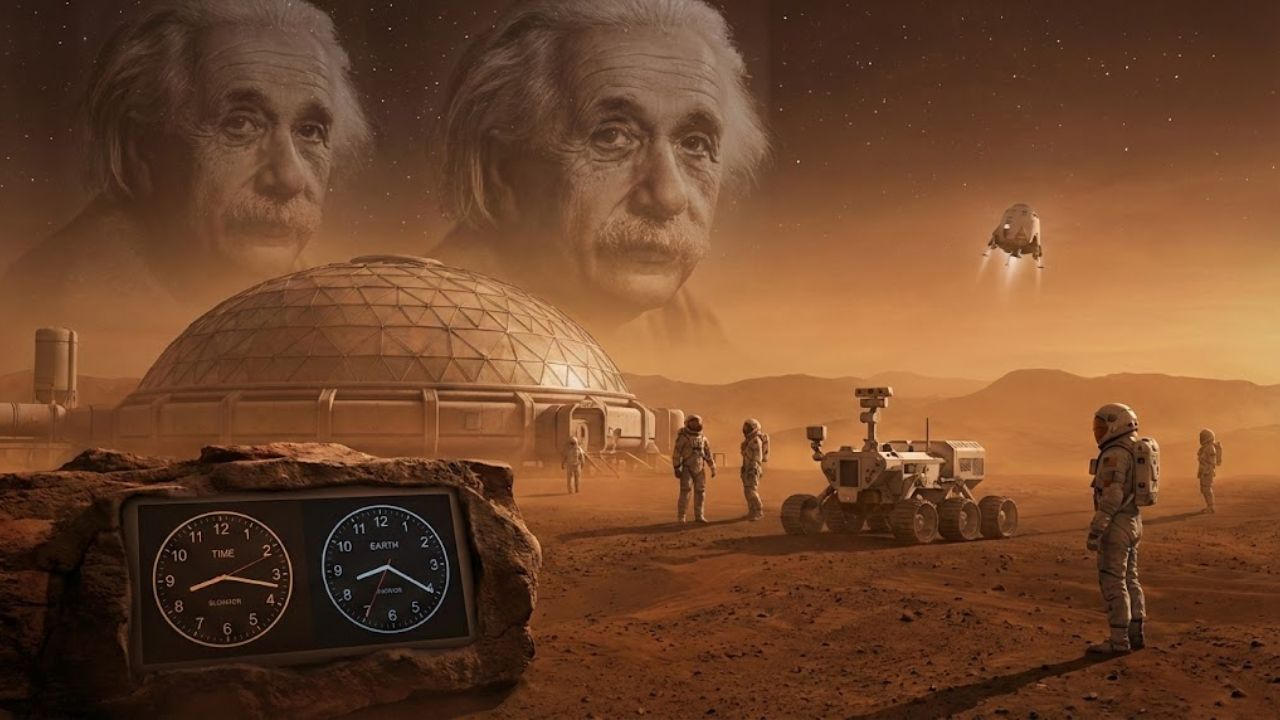
As humans continue to gaze towards the stars with the ambition of exploring new frontiers, the concept of time reveals itself as a complex and ever-present challenge. Albert Einstein’s theories predicted it, and now Mars has confirmed it – time flows differently on the Red Planet, creating a conundrum for future space missions. How will we adapt to this temporal shift, and what does it mean for the future of space exploration?
Imagine standing on the rust-colored soil of Mars, gazing up at the alien sky where the Sun appears as just a bright shimmer against the vastness of the cosmos. Every second that ticks by on Earth translates into a different experience on Mars, where a day is not quite 24 hours, and a year stretches longer than our terrestrial calendars. The very essence of time, a constant in our earthly lives, becomes a variable in the Martian landscape.
Time Dilation: A Relativity Conundrum
Albert Einstein’s theory of relativity introduced the world to the concept of time dilation – the idea that time is not a universal constant but can vary depending on the relative motion of objects and the strength of gravity. Mars, with its lower gravity and longer day, showcases this phenomenon vividly. A day on Mars, known as a sol, lasts approximately 24 hours and 39 minutes, throwing our Earth-bound perceptions of time into disarray.

To a human explorer on Mars, this seemingly small difference in the length of a day can have significant implications. The body’s internal clock, synchronized to Earth’s 24-hour cycle, must adapt to the Martian rhythm, potentially impacting sleep patterns, cognitive functions, and overall well-being. As we plan for future missions to the Red Planet, understanding and accommodating this time dilation challenge is crucial for the success and safety of astronauts.
| Earth Time | Mars Time |
|---|---|
| 24 hours | 24 hours, 39 minutes |
Engineering Solutions for Martian Time
With the confirmation of time dilation on Mars, engineers and scientists are tasked with developing innovative solutions to mitigate the challenges posed by this temporal disparity. Rovers, spacecraft, and future habitats on Mars will need to be equipped with systems that account for the unique cadence of Martian time, ensuring functionality and efficiency in an environment where each moment ticks to a different beat.
One approach to bridging the gap between Earth time and Martian time involves sophisticated software algorithms that synchronize mission operations with the Red Planet’s day-night cycle. By adjusting schedules, communications protocols, and power management systems, these solutions aim to harmonize human activities with the rhythm of Mars, enhancing productivity and minimizing disruptions caused by the time differential.

Impact on Human Health and Psychology
Beyond the technical challenges of adapting to Martian time, the impact on human health and psychology cannot be overlooked. Studies have shown that disruptions to the circadian rhythm, caused by changes in daylight hours and sleep patterns, can result in fatigue, cognitive impairment, and even mood disorders. As astronauts face extended missions to Mars, maintaining mental and physical well-being in the face of time dilation becomes a paramount concern.
Psychological adjustments to the perception of time must also be considered. On Mars, where the Sun rises and sets in a manner different from Earth, individuals may experience a cognitive dissonance as they recalibrate their internal clocks to match the Martian day. Strategies for coping with this temporal shift, such as light therapy, personalized schedules, and psychological support, are integral components of preparing for the psychological challenges of interplanetary travel.
| Challenges | Solutions |
|---|---|
| Disrupted circadian rhythm | Light therapy, personalized schedules |
The Social Constructs of Time
Time, a fundamental aspect of human society, serves as a cornerstone for organizing activities, setting schedules, and establishing a sense of order in our lives. On Mars, where time flows differently, our societal constructs around time face a paradigm shift. The intricate web of human interactions, routines, and expectations that is woven around the concept of time must adapt to the realities of Martian chronology, posing philosophical questions about the nature of time itself.

As we venture towards Mars and confront the temporal riddles of the Red Planet, our perception of time as a linear, unyielding force undergoes a transformation. What was once a fixed entity becomes malleable, subject to the gravitational whims and celestial mechanics that govern the universe. Exploring the depths of space not only expands our scientific knowledge but also challenges our fundamental beliefs about the nature of time and existence.
The Future of Interplanetary Timekeeping
As humanity marches towards a future where interplanetary travel becomes a reality rather than a distant dream, the question of how we keep time across the vast expanses of space looms large. From Mars to distant exoplanets, each celestial body carries its own temporal signature, inviting us to rethink our conventional notions of time. The development of universal timekeeping standards and technologies that adapt seamlessly to the time dilation effects of space will be essential as we embark on bold journeys beyond Earth.
Rethinking Time: Beyond the Martian Frontier
With each discovery and innovation in the realm of space exploration, we confront not only the mysteries of the cosmos but also the limitations of our human understanding. Time, once thought to be a fixed constant, reveals its fluidity and variability as we tread the Martian soil and gaze towards the distant stars. The future that awaits us among the planets demands a reimagining of time, a recalibration of our temporal compass to navigate the uncharted territories of space and the boundless expanse of the universe.

Frequently Asked Questions
How does time dilation work on Mars?
Time dilation on Mars is a result of its longer day compared to Earth’s 24-hour cycle, causing a discrepancy in the passage of time between the two planets.
What challenges does time dilation pose for future Mars missions?
Future Mars missions face challenges in synchronizing human activities with the Martian day, adapting to altered sleep patterns, and maintaining psychological well-being in the face of time differentials.
How are engineers addressing the issue of Martian time in spacecraft design?
Engineers are developing software algorithms to synchronize mission operations with Martian time, ensuring functionality and efficiency in space exploration.

What impact does time dilation have on human health?
Time dilation can disrupt circadian rhythms, leading to fatigue, cognitive impairment, and mood disorders in astronauts on extended missions to Mars.
How does the perception of time change on Mars?
On Mars, individuals may experience cognitive dissonance as they adjust to the different day-night cycle, necessitating psychological strategies to cope with the temporal shift.
What philosophical questions does time dilation on Mars raise?
The temporal variations on Mars challenge our societal constructs around time, prompting reflections on the nature of time and existence in the vastness of the universe.

What future technologies are needed to address interplanetary timekeeping challenges?
Universal timekeeping standards and adaptive technologies are crucial for navigating the time dilation effects of interplanetary travel and ensuring seamless coordination across celestial bodies.
How does time on Mars impact societal constructs around timekeeping?
The discrepancy in time between Mars and Earth necessitates a reevaluation of societal norms and constructs that revolve around the concept of time, sparking philosophical inquiries into the nature of temporal existence.










Leave a Comment